This page is an appendix to beach movement and the associated migration chart.
terms explained
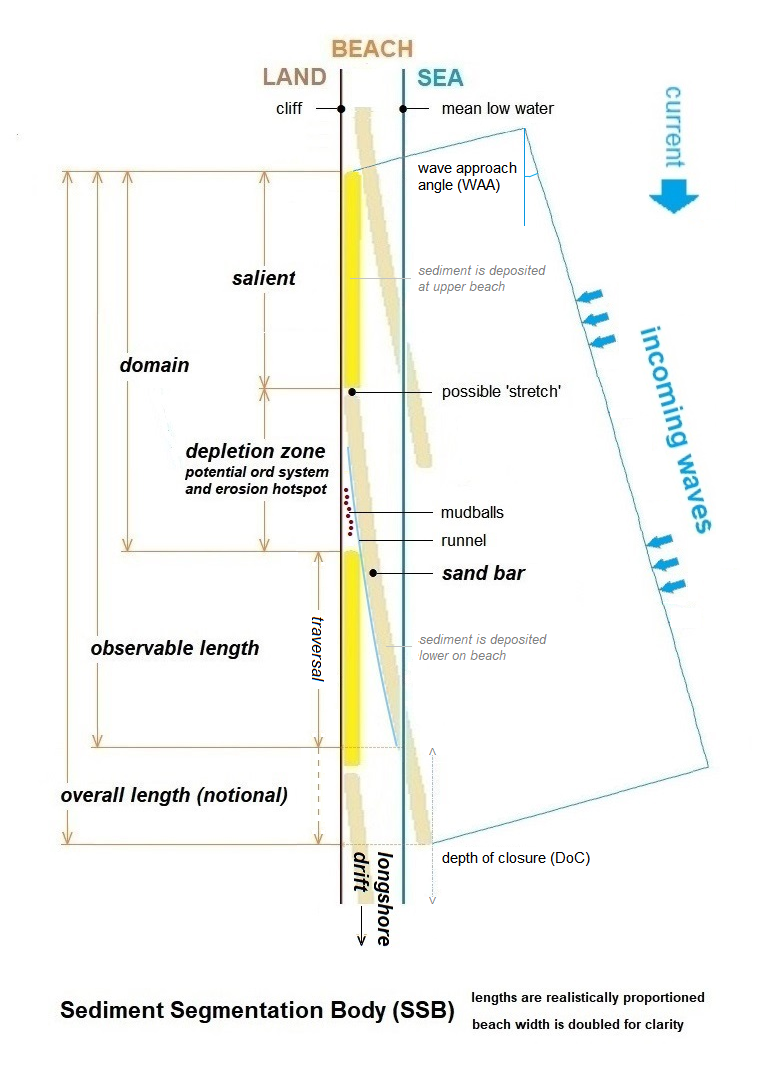
cliff
Essentially the boundary between land and beach.
A cliff face generally has a slope. At the top, where the land surface ends and at which all coastal erosion measurements are taken, is the cliff line. At the bottom, or the foot of the cliff, is the beach line. For the purposes of the figure, ‘cliff’ relates to the latter.
depletion zone
Shortest distance between one sand salient and the next. Beach level is low within the zone, which is generally the location of an ord system and increased cliff erosion. A depletion zone lacks protection by the sand bar of the SSB to the north.
depth of closure (DoC)
Depth of the sea away from the shore at which waves have no significant influence on the sea floor and where no consequential sediment transport takes place.
domain
Combined length of salient and depletion zone. The distance between the start of one salient and that of the next.
(erosion) hotspot
See hotspots.
longshore drift
Movement of sediment by tides in the direction of the sea current. See terminal groyne effect.
mean low water (MLW)
Average lowest level of the water line (i.e. at low tide), between neap and spring tides.
mudballs
See the mudballs page.
observable length
The extent of an SSB system (salient and sand bar) that can be seen at low tide, either from the beach or in an aerial image. An equivalent length may also be obtained from beach level countours charts.
overall length
Observable length plus estimated continued distance of a sand bar from the water line to the depth of closure. Difficult to determine with any accuracy.
ord
Short for ord system. See beach movement/ords.
runnel
A channel-like depression on the landward side of a sand bar, especially as part of an ord system. Typically contains sea water from the last tide. (Runnels may also be found in other situations.)
salient
Short for sand salient. Length of usually fine sand deposited in volume against the foot of the cliff during higher energy conditions. Level of the upper beach can rise significantly.
sand bar
Ridge of sand continuing for some distance from the southern tip of a salient, gradually crossing the middle and lower beach to enter the sea.
sediment
A broad term for sand of all grades, for shingle, pebbles, cobbles, and rocks. The loose material of the beach and the sea bed.
sediment segmentation body (SSB)
An entire system, as depicted in the above figure.
For the purposes of the model, SSBs are numbered, south to north. SSBs 1 to 4 have been lost at Spurn since the method was introduced. SSB-23 is in formation near Barmston. Between the two locations there are a nominal 18 SSBs.
traversal
Distance covered by a sand bar of one sediment segmentation body beyond the start of the next salient to the south. A bar in traversal may offer additional protection of the local cliff from wave action.
stretch
Slight depression between salient and sand bar. In periods of relative calm, much of a salient tends to lie above high water and static whereas the bar is covered daily by tides and affected by longshore drift.
wave approach angle (WAA)
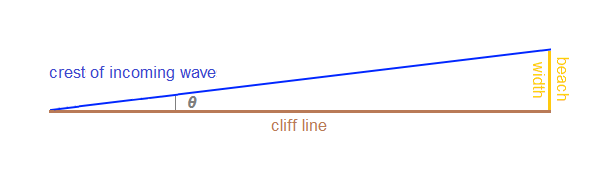
A wave approach angle can be represented in various ways. Here, it is the angle made by the crest of an incoming wave with the water line (where sea meets beach).
Sometimes, where beach width is implicated, the cliff line serves as the adjacent side of the wave angle triangle.
sediment zones
Behaviour of SSBs with respect to domain length and to pace of migration varies according to position along the coast.
Drawing on wave angle approach data, estimates of the above metrics have been applied to appropriate sections of the coast. These are arranged into sediment zones.
Values are the result of desktop calculation, though they are supported by inspection of the migration chart.
Locations of monitoring profiles are available at data summary and coordinates (spreadsheet)
◀ smaller screens ▶
zone
i
ii
iii
iii:iv
iv
v
v-a
v-b
vi
vii
viii
viii-a
ix
x
i
ii
iii
iii:iv
iv
v
v-a
v-b
vi
vii
viii
viii-a
ix
x
profiles
(14) to 17
18 to 22
23 to 37
41, 45 to 47
48 to 55
57 to 77
57 to 85
57 to 89
78 to 89
94 to 104
105 to 109
105 to 115
110 to 115
118 to 122
(14) to 17
18 to 22
23 to 37
41, 45 to 47
48 to 55
57 to 77
57 to 85
57 to 89
78 to 89
94 to 104
105 to 109
105 to 115
110 to 115
118 to 122
domain length
metres
1765.0
2397.2
2574.7
2726.5
2871.9
2962.5
2969.4
2977.1
3000.6
3009.6
2943.2
2962.5
2635.6
2437.0
metres
1765.0
2397.2
2574.7
2726.5
2871.9
2962.5
2969.4
2977.1
3000.6
3009.6
2943.2
2962.5
2635.6
2437.0
pace of migration
metres per year
294.0
399.3
428.9
454.2
478.4
493.5
494.7
495.9
499.8
501.3
490.3
493.5
439.0
406.0
metres per year
294.0
399.3
428.9
454.2
478.4
493.5
494.7
495.9
499.8
501.3
490.3
493.5
439.0
406.0
It may be seen that sediment increases in both length of domain and pace of migration as it departs Bridlington Bay (for convenience, the drift divide is placed at Profile 14, near Earls Dyke).
Once the coastline loses curvature, increments are very small and for some twenty-five kilometres or so there is little change. In the migration chart, sediment bodies become well defined with lengths of low beach contour between salients.
The inland curvature at the southern end of the coast is marked by a shortening of segments, and by slower movement. While values do not reduce to those of the northern curve, changes are more abrupt.
sediment zones data (all zones)
sediment zones data (no overlaps)
top
Page prepared by Brian Williams in June 2026.
The sediment segmentation model was prepared by Brian Williams
in 2015. Development continues.
Original wave approach angle data on which the sediment zone table is based was obtained, with permission of the authors, from: Pye, K and Blott, S J (2015), ‘Spatial and temporal variations in soft-cliff erosion along the Holderness coast, East Riding of Yorkshire, UK’, Journal of Coastal Conservation, 19, 6, 785-808 (abstract).